Water Damage Drying Time in Plum Creek: Pro Timeline
It is almost midnight in Plum Creek, you have just shut off the main water valve, and the question forming in your head is the same one every homeowner asks at this hour: how long is this going to take to dry out? You want a real answer, not a sales pitch. The honest version is that most residential water losses dry in three to five days when the work starts within the first day, but plenty of jobs run longer when the water sat, when category two or three water is involved, or when materials like plaster, hardwood, and dense subfloor are part of the structure. At Plum Creek Water Restoration, we have been drying out homes across central Indiana since 2018, and we have learned that giving you a clear timeline up front matters more than promising a number we cannot hit.
This guide walks you through the professional drying timeline the way our IICRC certified technicians actually plan it on site. You will see what happens on day one, what the moisture meters tell us by day three, and why some jobs wrap up by the weekend while others need a full week. If we look at your situation and believe the damage is small enough to handle yourself, we will tell you directly. That is the standard we hold ourselves to, and it is the reason BBB lists us at A+.
The Tuesday Night Dishwasher Call That Dried in 72 Hours
A homeowner on the north side of Plum Creek called us just after 9pm on a Tuesday. Her dishwasher supply line had let go sometime that afternoon while she was at work. By the time she walked in, water had spread across the kitchen tile, soaked into the dining room engineered hardwood, and was wicking up the drywall about four inches. She estimated 200 gallons on the floor.
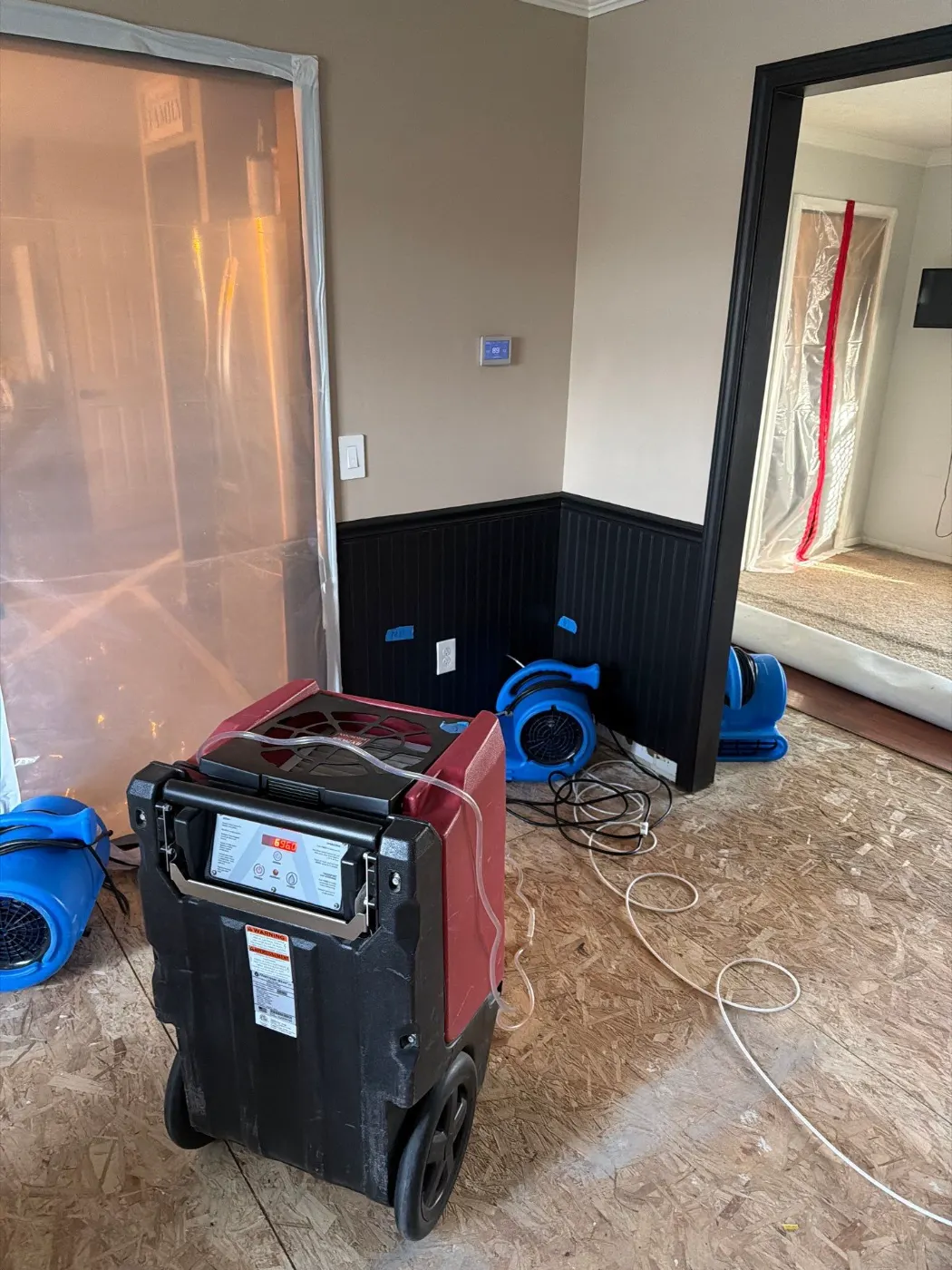
Our truck was on site within 90 minutes. We extracted the standing water in under an hour using truck mounted equipment, pulled the toe kicks off her cabinets, and drilled small ventilation holes behind the baseboards. By midnight we had nine air movers, two LGR dehumidifiers, and a HEPA scrubber running. Her case was clean Category 1 water, caught early, on materials that wanted to release moisture. We pulled equipment 72 hours later. Final moisture readings on the subfloor came back at 11 percent, right in line with the dry standard for that wood species. Total drying time: three days.
That is the best case version. Clean water, fast call, accessible materials. If your situation looks like this one, you can read more about dishwasher leak water damage and floor repair to understand what comes next after the drying phase wraps.
The Frozen Pipe Burst That Hid Behind a Wall
One of our trickier Plum Creek calls came in February. A pipe burst in an exterior wall on a Sunday morning during a deep freeze. The homeowner shut the main off within ten minutes and only saw a small wet spot on the ceiling below. He thought he had caught it. We came out to inspect because his insurance carrier asked for a moisture map.
Our thermal camera lit up like a Christmas tree. Water had traveled along the top plate and dropped into two stud bays, soaking the insulation and the back side of the drywall. Nothing visible from the room side. We cut access holes, pulled wet insulation, and set up cavity drying with injection systems that push warm dry air directly into the wall spaces. Total drying time on this one was five days. Without the thermal scan, that wall would have grown mold inside of three weeks and the homeowner never would have known until the smell showed up.
The Upstairs Bathroom Overflow on Hardwood
A Plum Creek family called us on a Saturday morning after a toddler had left the tub running upstairs for nearly an hour. Water came through the dining room ceiling below in three places. The upstairs bathroom had vinyl plank, which held up fine, but the dining room ceiling drywall and the hardwood floor in the hallway below were the real problem.
Hardwood is the material that surprises homeowners most. It looks dry on the surface within a day or two, but the moisture meter tells a different story for a week or longer. We used floor drying mats, which pull moisture up through the boards under negative pressure, paired with two LGR dehumidifiers in the affected area. Day six, the boards finally hit 9 percent. Had we pulled equipment at day three based on appearance alone, those planks would have cupped permanently within a month.
Get a Straight Timeline From a Local Crew
If water has come into your home tonight, the next decision matters more than any blog post can capture. Plum Creek Water Restoration runs a real 24 hour line in Plum Creek, our technicians are IICRC certified, and we will walk through your situation honestly before any equipment hits the floor. If the job is small enough for you to handle with a shop vac and a couple of fans, we will tell you. If it needs full extraction, professional drying, and insurance documentation, we will give you a clear timeline and stand behind it. Call when you are ready, and we will be there.
What We Tell Plum Creek Homeowners on the First Call
When you call Plum Creek Water Restoration, the first thing we ask is what got wet and when it started. Based on those two answers, we can give you a realistic window before we even arrive. Most Plum Creek jobs fall into a three to five day drying window. We will not promise 24 hours to look good on a sales call. If your job will take seven days, we will tell you seven days, document it for your insurance carrier, and stay on it until the readings prove the home is dry.
What Actually Drives the Timeline
After a few hundred jobs, the patterns are clear. The variables that determine how long your Plum Creek home takes to dry are:
- Water category. Clean Category 1 from a supply line dries faster than Category 2 grey water from a dishwasher discharge or Category 3 black water from a sewage backup.
- Time elapsed before extraction. Every hour water sits, it migrates further into materials. A call placed within six hours can cut your timeline in half compared to a 48 hour delay.
- Affected materials. Tile and laminate release water quickly. Hardwood, plaster, and dense subfloor take much longer. Concrete is the slowest.
- Equipment density. Industry standard is roughly one air mover per 50 to 70 square feet of affected area plus appropriate dehumidification capacity. Under equipping a job adds days.
- Ambient conditions. A humid Plum Creek July slows evaporation. A dry February with the furnace running speeds it up.
If you suspect water has reached areas you cannot see, our guide to professional water damage restoration covers what a proper inspection looks like and why guessing at moisture is the single most expensive mistake homeowners make.
The Basement That Took Nine Days
A homeowner in Plum Creek came home from a long weekend to find his finished basement under two inches of water. His sump pump had failed Friday night. By Monday afternoon, the carpet pad was saturated, the bottom 18 inches of drywall was soft, the baseboard trim had swelled, and the air smelled musty. He had owned the home for eleven years and had never seen anything like it.
This job ran nine days. Here is why. First, the water had been sitting for roughly 72 hours, which means it had already started migrating into the wall cavities and behind the carpet tack strips. Second, basements are inherently slower to dry because the concrete walls and slab hold moisture and the ambient humidity is naturally higher. Third, we had to perform a flood cut, removing the lower two feet of drywall and insulation, before drying could even start in earnest.
We ran 14 air movers, three dehumidifiers, and an air scrubber continuously. We took moisture readings twice a day. The slab and the framing were the slowest to release. By day nine, every material hit dry standard and we were able to release the home for reconstruction. If you are dealing with something similar, our deeper write up on flooded basement cleanup and professional drying walks through what nine days of equipment actually does to a space.
One detail from that job worth mentioning. The homeowner had a finished ceiling tile system in part of the basement, and we found water trapped above two of the panels that had not shown any visible sag. Without pulling those tiles and drying the joist bays above them, we would have left a hidden pocket of moisture that almost certainly would have produced mold within a month. Small finds like that are why proper inspection adds time on the front end but saves weeks on the back end.
Frequently Asked Questions
Can water damage dry on its own in Plum Creek without professional equipment?
Surface water on a sealed floor may evaporate, but anything that touched drywall, carpet pad, subfloor, or insulation will not dry to safe levels with fans and open windows. Plum Creek humidity, especially in summer, often keeps materials above the 16 percent moisture threshold where mold begins to grow within 24 to 48 hours.
How does Plum Creek Water Restoration confirm a property is actually dry?
We log moisture readings on a documented schedule using calibrated meters and compare them to dry standard readings taken from unaffected areas of your Plum Creek home. We do not pull equipment until those numbers match, and we leave the readings with you for your insurance file.
Why is my hardwood floor taking 10 days when carpet only took 2?
Hardwood is dense and finished, so moisture escapes slowly. Carpet and pad are porous and release water quickly once air movement is applied. The IICRC recognizes hardwood as one of the slowest materials to dry, and forcing it faster causes cracking and cupping.
Does homeowners insurance cover the full drying timeline?
Most policies cover the documented dry-out as part of mitigation, provided the cause of loss is covered. Plum Creek Water Restoration provides the moisture logs, equipment counts, and daily notes your Plum Creek adjuster needs. Sudden and accidental losses like burst pipes are typically covered, while gradual leaks often are not.
What happens if drying stops too early?
Trapped moisture inside wall cavities or under flooring leads to microbial growth, usually visible within two to three weeks as staining, musty odor, or peeling paint. That turns a mitigation job into a remediation job, often at three to five times the cost, which is why we never pull equipment based on appearance alone.
Have a restoration question?
Our IICRC certified Plum Creek crew is ready to help. Free assessments, estimate based on what we can sees, no pressure.